


Types of Safety Harnesses for Working at Height
When working at height, a safety harness is not only a mandatory legal requirement but also a critical factor in protecting workers’ lives. According to statistics from Vietnam’s Ministry of Labor, Invalids and Social Affairs, falls from height account for a significant proportion of serious workplace accidents in the country.
In a Fall Arrest System, safety harnesses play a vital role in holding and distributing impact forces during a fall, ensuring the worker is safely secured instead of falling freely. However, each type of harness is designed for specific purposes and standards—choosing the wrong one can be just as dangerous as not using one at all.
FPR Supply will help you clearly distinguish the most common types of safety harnesses available today, from technical standards and structure to real-world applications across different industries.
What Is a Safety Harness for Working at Height?
A safety harness is a type of Personal Protective Equipment (PPE) designed to protect workers from fall hazards when working at height. It is worn directly on the body and connected with connectors, energy absorbers, and anchor points to form a complete fall protection system.
The Role of Safety Harnesses in Fall Protection Systems
In a standard Fall Arrest System, a safety harness performs three main functions:
- Stops the worker in the event of a fall
- Distributes impact forces across the body, especially the chest, shoulders, and thighs, reducing internal injuries
- Maintains a safe upright position (head up) after a fall, helping prevent suspension trauma
Full Body Harness vs. Half Body Harness
| Criteria | Full Body Harness | Half Body / Waist Belt |
|---|---|---|
| Protection Area | Shoulders, chest, back, thighs | Waist and hips only |
| Fall Arrest Capability | Yes – distributes force across body | No – positioning only |
| Standards | EN 361, ANSI Z359.11 | EN 358 (positioning only) |
| Applications | Construction, telecom, rope access | Utility poles, steel structures (with fall arrest system) |
Important Note: In Vietnam, according to Circular 16/2021/TT-BXD and TCVN 7802-1:2007, workers at heights above 2 meters are required to use full body harnesses combined with certified fall protection systems.
Types of Safety Harnesses for Working at Height
1. Fall Arrest Harness (EN 361)
This is the most critical type of safety harness. It is the only harness designed to stop a worker during a free fall and distribute impact forces safely.
Structure:
- Webbing (polyester or polyamide): durable, abrasion-resistant, UV-resistant
- Metal hardware: aluminum alloy or stainless steel, secure locking
- D-rings: attachment points for lanyards or fall arrest devices
- Shoulder, chest, and leg straps: evenly distribute forces
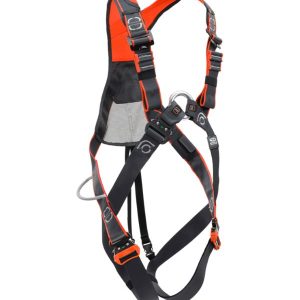
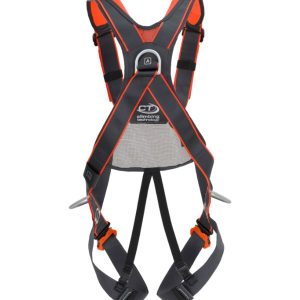
EN 361 Requirements:
- Adjustable chest, shoulder, and leg straps
- Minimum webbing width: 40 mm
- Fall arrest attachment points located above the body’s center of gravity
- Marked with the letter “A”
- Contrasting stitching for easy inspection
Dynamic Load Testing:
- 100 kg test mass
- Two drops from 4 meters
- Tested in upright and inverted positions
- No tearing or failure allowed; body must remain secured
2. Work Positioning Harness (EN 358)
Used to hold workers in place while allowing hands-free operation, especially on poles, towers, or steel structures.
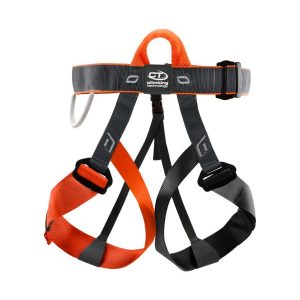
Features:
- Padded waist belt for comfort
- Two side D-rings for positioning
- Optional front or rear attachment points
Important: EN 358 harnesses do NOT protect against free falls. They must be used with a fall arrest system when fall risk exists.
3. Combination Harness (EN 361 + EN 358)
A versatile solution that combines both fall arrest and work positioning features.
Benefits:
- One harness for multiple tasks
- Reduced equipment weight
- Increased efficiency
Applications:
- Telecom tower climbing
- Industrial maintenance
- Rope access
- Wind energy sector
4. Seat Harness (EN 813)
Designed for prolonged suspended work, with a main attachment point at the front.
Applications:
- Rope access
- High-angle rescue
- Tree climbing
- Facade maintenance (cleaning, painting, repairs)
Often used with rope descenders compliant with EN 12841-C.
5. Arborist Harness (EN 358 + EN 813)
Specialized harness for tree care, designed for flexibility and multi-directional movement.
Key Features:
- Sliding rope bridge for lateral movement
- Side D-rings for positioning
- Lightweight, mobility-focused design
Applications:
- Tree pruning and cutting
- Urban tree maintenance
- Fruit harvesting at height
6. Rescue Harness / Evacuation Triangle (EN 1498)
Used for emergency evacuation and rescue operations.
EN 1498 Classes:
- Class A: Upright or supine position (underarms & back support)
- Class B: Seated position (hips and thighs)
- Class C: Head-down position (ankle support)
Applications:
- Confined space rescue
- Construction emergencies
- Industrial evacuation
Summary Comparison Table
| Harness Type | EN Standard | Fall Arrest | Positioning | Main Use |
|---|---|---|---|---|
| Full Body Harness | EN 361 | Yes | No | Construction, roofing |
| Positioning Harness | EN 358 | No | Yes | Poles, telecom |
| Combination Harness | EN 361 + EN 358 | Yes | Yes | Maintenance, rope access |
| Seat Harness | EN 813 | No* | Yes | Rope access, rescue |
| Arborist Harness | EN 358 + EN 813 | Optional | Yes | Tree care |
| Rescue Harness | EN 1498 | No | No | Emergency rescue |
How to Choose the Right Safety Harness
Assess fall risk
- Free fall risk → EN 361 required
- Positioning only → EN 358
- Both → combination harness
Nature of work
- Long-duration positioning → padded harness
- Suspended work → seat harness
- High mobility → arborist harness
Check certifications
- EN (EU), ANSI (US), TCVN (Vietnam)
- Verify labels and expiration dates
Fit and comfort
- Must fit snugly, not too tight
- Allow one-hand space between body and straps
- Test movement before use
Lifespan and maintenance
- Typical lifespan: 3–5 years
- Inspect before each use
- Replace immediately if damaged or after a fall
Vietnamese Regulations on Safety Harness Use
- Law on Occupational Safety and Hygiene (2015): Employers must provide PPE
- Circular 16/2021/TT-BXD: Safety requirements for working at height
- TCVN 7802-1:2007: National standard for safety harnesses
- Decree 12/2022/ND-CP: Fines up to 75 million VND for violations
Conclusion
Understanding and selecting the right type of safety harness is the first and most critical step in protecting lives when working at height. Each type—EN 361 fall arrest harness, EN 358 positioning harness, EN 813 seat harness, or EN 1498 rescue harness—serves a specific purpose.
Always ensure that you:
- Choose the correct harness for the job
- Verify certifications (EN, ANSI, TCVN)
- Inspect equipment before every use
- Train workers on proper usage
- Replace any harness that is damaged or expired
Safety is not optional—it’s essential.